
Green River Energy Center: Utah's Largest Solar Farm
In June 2026, Utah's Green River Energy Center came online, featuring nearly one million solar panels and 500 batteries. The facility, built on former coal country, supplies power to Salt Lake City and marks a major shift in the state's energy landscape.
Green River Energy Center: Utah's Largest Solar Farm
In June 2026, a new energy landmark emerged in Utah's Castle Valley: the Green River Energy Center, a solar and battery storage facility with nearly one million photovoltaic panels. Satellite images from NASA's Landsat 8 capture the transformation of this arid landscape from empty desert to a sprawling renewable energy plant. Located about 130 miles southeast of Salt Lake City, the facility is now one of the largest solar installations in the state and a key player in Utah's accelerating shift away from coal.
From Coal to Solar: Castle Valley's Energy Transition
Castle Valley has a long history tied to coal. Mining operations on the slopes of the Wasatch Plateau have been active since the late 1800s, and Utah even adopted coal as its state rock. For decades, coal-fired power plants dominated the region's energy production. But the energy landscape is changing. The Green River Energy Center, built on previously undeveloped land, repurposes existing transmission lines originally used for coal plants, allowing it to feed clean electricity into the grid without building new infrastructure.
The Green River Energy Center: Numbers and Impact
The Green River Energy Center boasts 400 megawatts of solar-generating capacity paired with 400 megawatts of battery storage, housed in roughly 500 batteries. The nearly one million photovoltaic panels cover several square miles of the valley floor. According to project staff, the facility can produce enough electricity for more than 100,000 homes. With integrated battery storage, the plant can generate power around the clock, even when the sun is not shining. The electricity is slated to supply Salt Lake City and other areas across Utah, according to news reports.
Satellite Views: Before and After
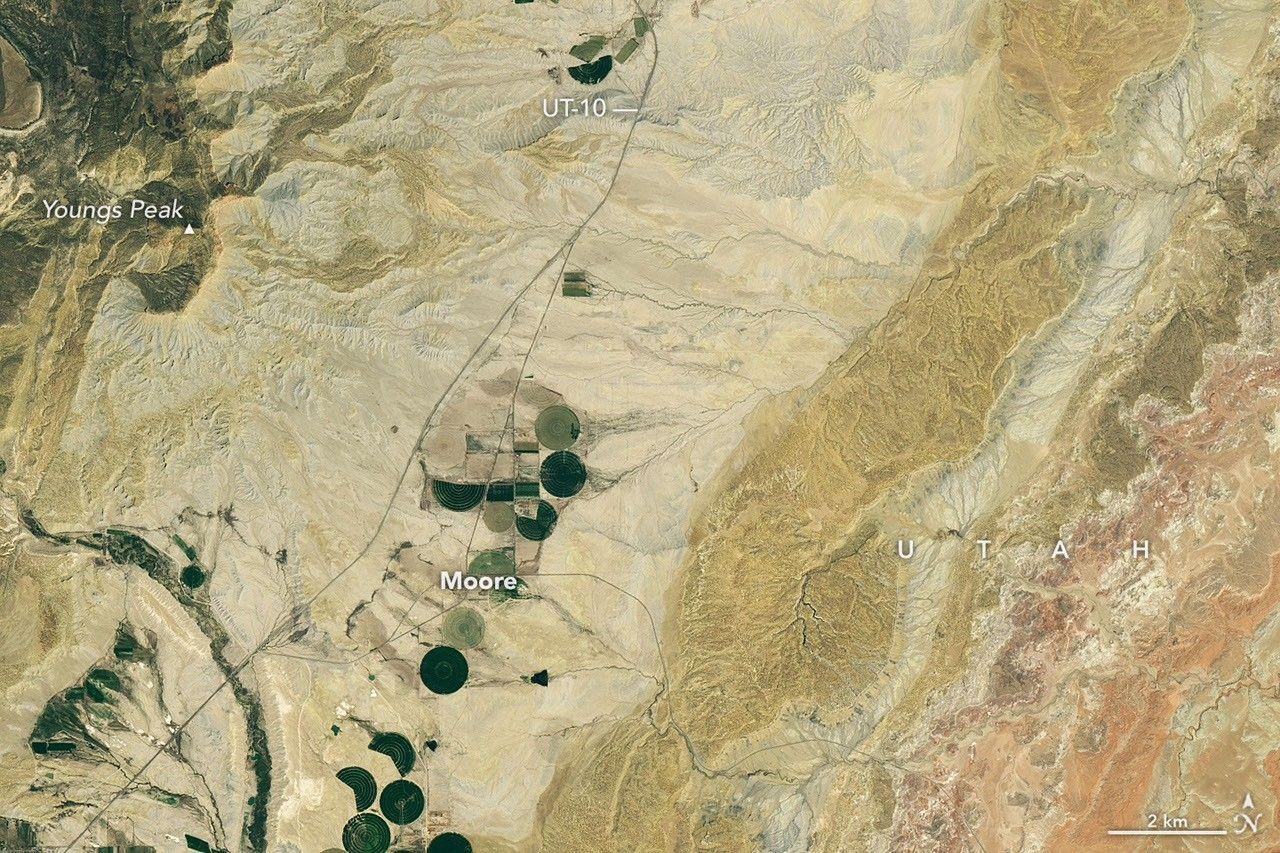
NASA's Earth Observatory released two Landsat 8 images that starkly illustrate the transformation. The left image, acquired on June 16, 2024, shows a dry, tan-colored valley with a few circular irrigated fields. The right image, taken on June 6, 2026, reveals the same valley now filled with grid-like arrays of solar panels. The images were captured by the OLI (Operational Land Imager) on Landsat 8 and processed by Lauren Dauphin of NASA Earth Observatory.
Solar's Growing Role in Utah's Energy Mix
Utah's energy mix is shifting rapidly. In 2025, coal fueled about half of the state's electricity generation, down from about 75 percent in 2015. Meanwhile, solar grew to account for about 14 percent of generation in 2025, up from nearly zero a decade earlier. The U.S. Energy Information Administration expects many utility-scale solar and battery storage projects to come online across the country in 2026, and the Green River Energy Center is a leading example of this trend.
Why Satellite Data Matters
Satellite data from missions like Landsat provide valuable tools for planners and policymakers involved in energy transitions. They help assess the potential of renewable energy systems, track their adoption, and monitor performance over time. As solar and other renewables continue to expand, such imagery will become increasingly important for understanding and managing the changing energy landscape.
Keep reading